Posts

Checking on Hive Split

Image
 

Honey Harvest 2025

Image
 

Splitting a Hive

Image
 

It's Getting Crowded

Image
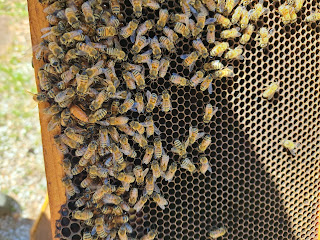
 In the Spring and early Summer the hives really build up and the danger of swarming is ever present. When you see them building up you have to give them room to grow. If they believe they are out of room they will start planning to swarm. I added on to my hive that was growing very large to give them room. Even after giving them more room they just kept growing in number. I made a walk away split yesterday to give them even more room. A walk away split is where you move some bees, brood with nurse bees on them, and frames with some honey and pollen on them. They will have to make a queen in the hive without one. It gets hard to do hive checks when you have so many boxes to check. Good news they have been bringing in lots of honey this year so I should be able to harvest soon.      

Spring has Sprung

Image
 You have to love the spring time. New life is all around. The trees and flowers are starting to bloom and the birds are singing. Of course many people curse the spring because of pollen, but not we bee keepers. Pollen is needed by our bees to produce new brood for the coming honey harvest. My bees have been collecting pollen through out February this year. Our red maples start budding in February and the daffodils are blooming, as well as, many weed varieties like dandelion and henbit.  Some years I have had trouble getting my bees to live through the winter but this year they have done wonderfully. The hive is strong and vibrant. I am treating with Formic Acid Pro strips as it needs to be between 50 and 85 degrees and it does not contaminate honey supers, so it makes the best treatment for this time of year. Always do 1 strip 10 days then second strip 10 days as I did two strips 14 days and it killed my hive. Also, open the entrance excluder as the directions say. I did a th...

Really Cold Weather on the Way

Image
 Here in South Carolina we get a little cold weather in January or February, but nothing too bad. That is normally. We have had affects from the polar vortex this week dropping temps into the teens with wind chills to 0. In order to prepare I wanted to make sure my bees had the best chance of survival. As you know they like to keep it 90 degrees around the queen at all times. In order to do this they flap their wings vigorously. This causes them to use energy that has to be replenished with food. Since I robbed them in the Summer I have to make sure they have plenty. I fed them sugar water in late fall so they could store it for winter but I don't want to use that with these freezing temperatures, so I feed them a solid over winter food. There are many different ones out there and many have nutrients and other things to help as well. They don't need much if any pollen as they are not making lots of brood. They mostly need carbs. We are just trying to get them to survive. You ca...

Preparing for Winter

Image
Preparing for Winter Video Honey bees prepare for winter in several ways to ensure the survival of the colony: 1. Honey Storage: Bees work hard in the warmer months to collect nectar and pollen, which they convert into honey. This stored honey serves as their primary food source during winter when foraging is impossible. 2. Reducing Activity: As the temperature drops, honey bees become less active. The queen reduces her egg-laying, and the colony's population decreases, as fewer worker bees are needed to maintain the hive. 3. Forming a Cluster: To stay warm, bees form a tight cluster around the queen in the hive. The outer bees shiver their flight muscles to generate heat, while the bees in the center of the cluster stay warm. The cluster moves around the hive as needed to access stored honey. 4. Sealing the Hive: Bees use propolis (a resinous substance) to seal any cracks in the hive, insulating it against cold drafts. This helps maintain the temperature inside the hiv...

A Time to Beard

Image
 In late August in South Carolina, as in other places, we sometimes see bees bearding in front of the the hive box. This can happen for several reasons and should not be mistaken for preparing to swarm. The times I have seen a hive getting ready to swarm there was a large number of bees in front and flying around the hive.  Bearding happens because it is hot in the hive in late afternoon and they are helping to keep the hive cooler by hanging outside. Also, when the nectar dearth happens, there is not much nectar to be found, they don't have as much work to do. Also, there may not be any empty cells for nectar. Always do a hive check and make sure everything looks good and there is room for growth. See a bearding hive at 5:16 PM vs 2:35 PM. 5:16 PM 2:35 PM  Here is a pre-swarm hive. You can see a big difference. This was happening in April. I put them back in the hive but swarming was on there mind and eventually they did swarm.  

Honey Harvest July 2024

Image
Honey Harvest 2024  

Super Installation 2024

Image
 

New Packages for 2024

Image
We have Installed a couple new packages for 2024.  

Honey Harvest 2023

Image
 Honey Harvest 2023  

First Month With New Packages

Image
Below are the normal time frames that new packages go through in the first month. Day 1-3: Installing the Package The first few days after installing the package are crucial. You'll need to make sure that the bees have access to food and water, as they won't have any stored up yet. It's also important to check that the queen has been released from her cage and has begun laying eggs. During this time, the bees will be focused on building comb and establishing the colony. Yes my queens are out, can you spot her. Day 4-14: Building Comb and Establishing the Colony During this time, the bees will be busy building comb and expanding the size of the colony. You may notice that the bees are bringing in more pollen and nectar as they start to establish their food sources. The queen will also be laying more eggs, and the colony will be growing at a rapid pace. Yes mine are building brood, pollen and honey stores.   Day 15-30: Checking the Brood and Health of the Colony By the ...

New Packages Installed

Image
  Installing honey bee packages is an essential step in beekeeping for those who want to start their own hive or expand an existing one. Honey bee packages are usually sold by bee suppliers, and they contain a queen bee, a certain number of worker bees, and some food to sustain the bees during transportation. In this blog, we will provide a step-by-step guide on how to install honey bee packages, including some tips to ensure a successful installation. Step 1: Prepare the hive Before you install the honey bee package, you need to make sure that your hive is ready. The hive should be clean, free of debris and pests, and have frames with foundation or drawn comb. You can also add a feeder filled with sugar syrup to provide extra food for the bees. Step 2: Choose the installation location Choose a location for the hive that is sheltered from the wind and receives sunlight for at least six hours a day. The hive should also be placed in an area with good drainage, so the bee...